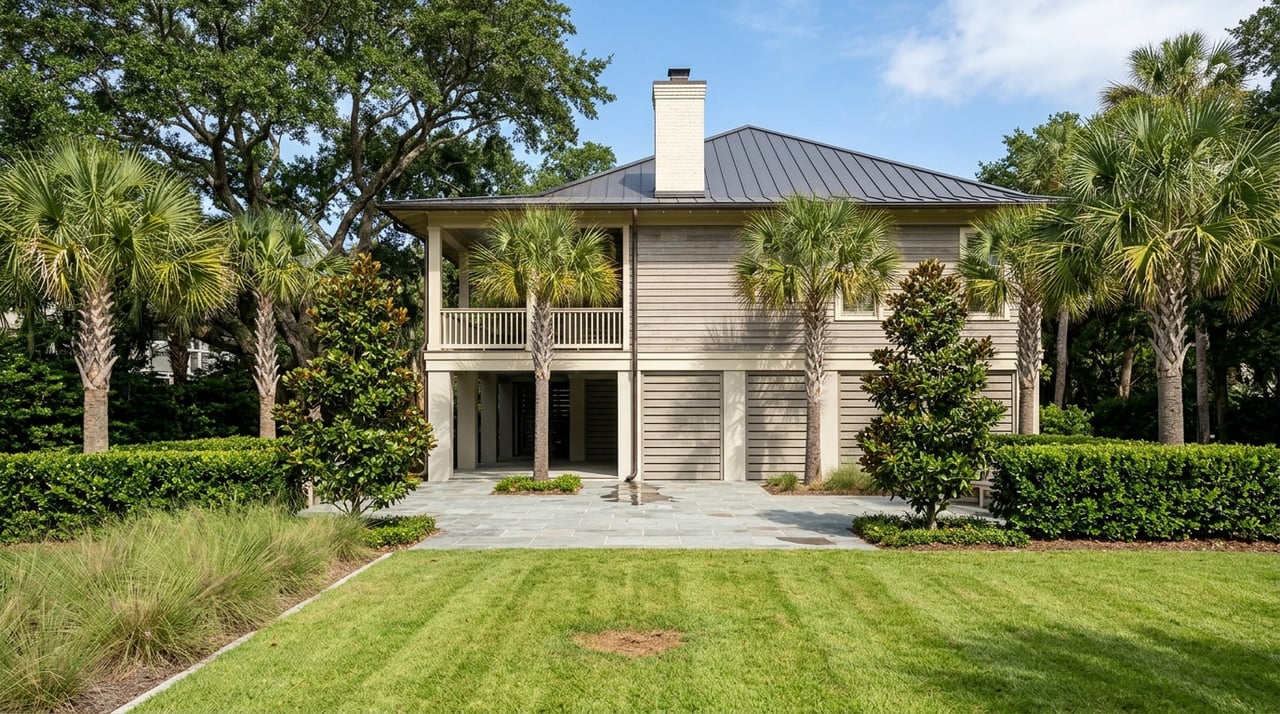
At the Ocean Club complex in Wild Dunes, engineers spent part of 2025 walking the buildings and came back with a number nobody wanted: a structural and cosmetic renovation large enough that individual owners are now facing special assessments north of $125,000 apiece, on top of whatever they already pay in regime fees. The work is underway through 2025 and 2026.
At the same time, on the same seven-mile island, a different set of numbers is moving in the opposite direction. If you've started comparing Isle of Palms to Wild Dunes on price alone, you've probably noticed the two don't agree with each other, and that disagreement is the story worth understanding before you write an offer.
The number that doesn't match the neighborhood
In January 2026, the median sale price for a home in Wild Dunes was $1.3 million, down roughly 19.5 percent from a year earlier. Over that same stretch, the rest of Isle of Palms, the ungated majority of the island outside the resort gates, moved the other way: median sale price up around 18 percent to roughly $1.77 million. Price per square foot tells the same split story. Wild Dunes is running about $777 per square foot against roughly $900 for the rest of the island, a gap of well over a hundred dollars a foot between two markets separated by a single security gate.
If falling prices meant a falling market, you'd expect homes to sit longer, sell for less relative to asking, and pile up in inventory. Wild Dunes is doing none of that. Homes there are moving faster than a year ago, averaging 56 days on market instead of 93, and they're still closing at roughly 95.6 percent of list price. That combination, a lower median with a faster sale, is not what a cooling market looks like. It's what a market looks like when it's finding a new price level for a specific reason, not losing buyers across the board.
The reason sits in the building stock, not the location.
Where the discount actually comes from
Wild Dunes isn't one housing market. It's a mix of single-family homes on their own lots and a dense cluster of condo and villa buildings, many dating to the 1980s and 90s, that carry their own insurance, their own reserve funds, and their own maintenance timelines. When one of those buildings needs a major structural repair, as Ocean Club does now, the assessment lands on current owners and the resale value of every unit in that building takes the hit immediately, whether or not a buyer ever sees the engineering report.
That's a building-level event pulling down a neighborhood-level median. The rest of Isle of Palms, largely single-family homes without a shared regime to assess, doesn't carry that same exposure, which helps explain why its median kept climbing while Wild Dunes softened.
The state's own coastal insurance market report backs up why this is happening now rather than five years ago: wood-frame condominium buildings over fifty years old near the ocean have had a genuinely hard time finding affordable coverage in the standard insurance market, forcing many associations toward higher-cost alternatives or steeper self-insurance through reserves and assessments. Wild Dunes isn't over fifty years old as a whole, but its oldest buildings are closing in on that age, and insurers are pricing that age curve into premiums well before a building hits the fifty-year mark.
What the fee stack actually looks like
A buyer comparing a listing inside the gates to one outside them is rarely comparing apples to apples on carrying cost, even when the sale prices land close together. Here's roughly how the recurring cost stack differs, based on current published fee schedules:
| Cost | Non-gated Isle of Palms home | Wild Dunes single-family home | Wild Dunes condo or villa |
|---|---|---|---|
| Island or community HOA | None | Wild Dunes Community Association assessment: $983/year (2026) | Same $983/year, plus a separate building regime fee |
| Regime fee | Not applicable | Not applicable for most detached homes | Roughly $400 to $1,200/month depending on building age and amenities |
| Flood, wind, and hazard insurance | Required in the same FEMA flood zones as the rest of the island | Roughly $9,200 to $16,500/year in AE zones, $20,000+ in VE zones | Often bundled into the regime fee, with insurance assessments common in older buildings |
| Golf or club access | Public courses and dining, no membership required | Not included with ownership; purchased separately | Same, not included |
| Transfer fee at closing | None | 1 percent of purchase price, rising to 1.25 percent for closings on or after September 1, 2026 | Same, plus some buildings' own capital contribution fee |
That transfer fee increase is real and it's coming, but it's a one-time cost applied at closing. It raises the entry price slightly. It doesn't explain a 38-percentage-point swing between two adjacent markets, and it shouldn't be confused with the recurring costs actually driving the divergence.
The membership that doesn't come with the house
The detail that surprises the most buyers is that owning property in Wild Dunes, whether a $500,000 condo or a $5 million oceanfront home, does not include access to the golf courses, tennis center, or resort pools. Those amenities belong to the Wild Dunes Club, a separate operation owned by Lowe and Dart Interests, and access requires its own membership purchase on top of the home.
The Signature golf tier runs a $50,000 non-refundable initiation fee plus $637 a month in dues. A Swim tier is available for $10,000 initiation plus $139 a month if golf isn't the draw. Either way, that membership is a personal purchase, not a property right. It doesn't transfer when you sell. The next owner starts from zero and pays full initiation at whatever the going rate happens to be. Compare that to a club like Kiawah, where roughly half of a member's initiation fee typically returns at resale, and the difference in what you're actually buying becomes clearer. In Wild Dunes, club access is closer to a subscription than an asset. You're renting a lifestyle, not building equity in it.
What this means if you're choosing between the two
None of this makes Wild Dunes a bad option or the rest of the island automatically the better one. It means the comparison has to happen at the level of the specific property, not the neighborhood average. A newer single-family home in a section like Beachwood, where owners typically pay only the WDCA assessment and nothing else, carries a very different financial profile than a 1980s-era condo in a building that hasn't yet had its structural review. Both are technically "Wild Dunes." Only one of them is exposed to the kind of assessment risk currently playing out at Ocean Club.
If your priority is beach access, flood zone exposure won't change based on which side of the gate you're on. All of Isle of Palms sits in FEMA-designated flood zones, and insurance requirements apply island-wide. What changes behind the gates is the fee structure layered on top: the association assessment, the regime fee if you're in a shared building, and the optional but sizable cost of actually using the amenities you're paying HOA dues to fund access near, not access to.
Before writing an offer on anything inside Wild Dunes, ask for the building's most recent reserve study and HOA meeting minutes. That single request will tell you more about where a specific property sits relative to the current price divergence than any island-wide median ever will.
A few questions worth asking directly
Does buying outside the gates mean giving up the beach? No. Non-gated Isle of Palms shares the same six miles of Atlantic coastline, the same flood zones, and the same schools as Wild Dunes. What you're paying for behind the gates is privacy, landscaping, and proximity to resort amenities, not the water itself.
Is every building in Wild Dunes facing a six-figure assessment like Ocean Club's? No, and that's exactly the point. Building age and reserve fund health vary widely across the resort. Some single-family sections carry almost no shared building risk. The only way to know where a specific property sits is to review its reserve study and recent association minutes before you make an offer.
Does the September 1 transfer fee increase explain the price gap? No. The rise from 1 to 1.25 percent is a one-time closing cost that raises entry price slightly. The median price divergence between Wild Dunes and the rest of the island is being driven by recurring carrying costs and building-specific assessment risk, not by a fee paid once at the closing table.
Comparing Wild Dunes to the rest of Isle of Palms on median price alone will point you in the wrong direction. If you're weighing the two seriously, Crown Coast can walk the actual building history, reserve position, and fee stack on any specific property you're considering, so the number you're comparing is the right one.