If downtown Charleston feels a little hard to decode at first, you are not alone. The historic core packs a lot into a relatively small area, and each district has its own rhythm, streetscape, and daily feel. This guide gives you a simple way to understand Charleston’s most iconic downtown districts so you can picture how each area lives, walks, and works before you start narrowing your search. Let’s dive in.
Why downtown Charleston feels distinct
Downtown Charleston is shaped by water, history, and preservation. The city sits on Charleston Harbor where the Ashley and Cooper Rivers meet, and its historic core has long been defined by careful stewardship of older buildings and streets.
That preservation mindset is not new. Charleston adopted the first preservation ordinance in the United States in 1931, and the Board of Architectural Review still oversees visible exterior changes in historic districts today. For you as a buyer or homeowner, that helps explain why downtown Charleston looks and feels so consistent from block to block.
A simple way to read the area is this: South of Broad sits closest to the harbor edge, Broad Street works as a transition, the French Quarter and Market area form a cultural heart, and King Street acts as the retail spine. If you keep that mental map in mind, the rest starts to make sense.
South of Broad at a glance
South of Broad is one of the most recognizable parts of downtown Charleston. City code defines it as the area bounded by Broad Street to the north, the Cooper River to the east, and the Ashley and Cooper Rivers to the south, with the Ashley River to the west.
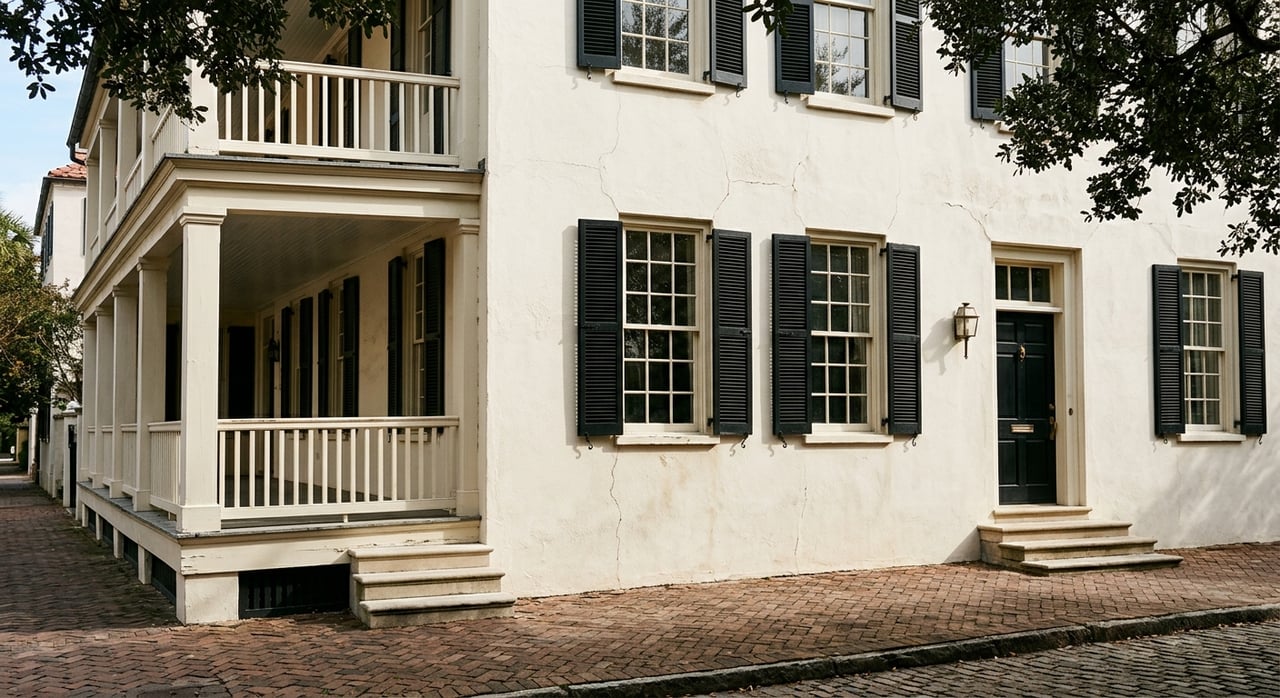
For many buyers, this district reads as the most residential-feeling part of the historic downtown core. The broader Old and Historic District is known for Charleston single houses, tiered piazzas, and architecture that includes Georgian, Regency, and Classic Revival styles.
What South of Broad feels like
This is the district to think of as formal, historic, and largely residential rather than retail-driven. The setting is closely tied to Charleston’s landmark architecture and harbor-edge scenery, which gives the area a quiet sense of permanence.
You can also anchor the area with familiar places. The Nathaniel Russell House is identified as South of Broad, and it sits within walking distance of the High Battery and White Point Garden. That makes it easy to picture daily life here as one connected to historic streets, notable homes, and waterfront walks.
Why buyers notice South of Broad
If you are drawn to iconic Charleston architecture, this area often stands out first. The appeal is less about constant commercial activity and more about the built environment, the preservation character, and proximity to the water.
In simple terms, South of Broad is often the downtown district people associate with landmark houses and a more private residential atmosphere. If your goal is a home base that feels rooted in Charleston’s historic fabric, this is an important area to understand.
French Quarter and Market area
The French Quarter is one of the clearest expressions of Charleston’s historic identity. Charleston’s history materials highlight the French Quarter and Battery areas as especially rich in the city’s story, and older district documentation ties the area to the old walled city.
In today’s context, the French Quarter stands out as a culture-first downtown pocket. It blends historic streets with museums, performance venues, market activity, churches, and easy access to the harbor.
What defines the French Quarter
Several landmarks help bring the district into focus. The Gibbes Museum sits on Meeting Street just south of the Market area, Dock Street Theatre remains one of the city’s major performing arts venues, and Market Hall with the market sheds continues to anchor one of Charleston’s best-known public spaces.
The market sheds still host Lowcountry arts-and-crafts vendors, which adds to the area’s active street life. Nearby, Waterfront Park stretches along Charleston Harbor as an eight-acre linear park and pier, reinforcing the district’s connection to both the city and the water.
Why the French Quarter feels walkable
For many readers, this is the easiest district to picture if you want a day that mixes culture and convenience. You can move between museums, theater, churches, market browsing, and the waterfront without covering much ground.
That blend gives the French Quarter a visitor-friendly but still deeply historic identity. If you want a downtown setting that feels immersed in Charleston’s public life, this district often rises to the top.
King Street as the retail spine
If South of Broad feels more residential and the French Quarter feels more cultural, King Street is downtown Charleston’s energy corridor. City materials place King Street within the Central Business District, along with the Market area and sections of Broad, East Bay, and Meeting Streets.
Planning and retail materials consistently describe King Street as the anchor of downtown retail. The 2024 King Street Profile tracks the corridor from Line Street to Broad Street and reported overall occupancy at 92%, with Upper King at 87%, Middle King at 94%, and Lower King at 97%.
What you can expect on King Street
King Street is known for a mix of fashion, art, antiques, home décor, and food. City materials also note its location near the College of Charleston, nearby residential areas, and hotels, which helps explain the mix of locals, students, and visitors you see along the corridor.
For a home search, that makes King Street the most obvious choice if you want to live near daily downtown activity. It is the part of Charleston where commercial energy is most visible and where street life often feels the most active.
Why King Street matters in a home search
King Street is also the corridor most clearly managed as a special commercial environment. City resources for the Central Business District include parking, rideshare zones, truck routes, and other operational details that help support heavy activity.
That practical layer matters if you are trying to imagine everyday life, not just a weekend visit. If your ideal downtown experience includes shops, dining, and a lively sidewalk scene close at hand, King Street deserves close attention.
How the districts compare
If you are trying to sort through downtown Charleston quickly, it helps to focus on the clearest distinction between these areas: residential feel, cultural focus, and commercial energy.
Here is a simple side-by-side view:
| District | Best known for | Overall feel |
|---|---|---|
| South of Broad | Landmark houses, harbor-edge walks, historic residential fabric | Formal and mostly residential |
| French Quarter | Museums, theater, market access, waterfront proximity | Culture-forward and walkable |
| King Street | Shopping, dining, and downtown activity | Commercial and energetic |
This is not a ranking. It is a practical framework to help you decide which kind of downtown Charleston experience fits your lifestyle goals best.
What preservation means for owners
Across all of these districts, preservation is part of the ownership experience. In Charleston’s historic districts, the Board of Architectural Review reviews visible new construction, alterations, and renovations.
That matters because it helps protect the character that draws so many people downtown in the first place. It also means changes to a property’s exterior may involve an added layer of review, which is worth understanding early if you are thinking about updates or long-term plans.
The city also notes that the Old and Historic District includes narrow streets and lived-in residential areas. That helps explain why tourism and day-to-day activity are managed differently here than they might be in a newer suburban setting.
How to use this guide in your search
If you are just beginning your downtown Charleston home search, try starting with the lifestyle you want most. Do you picture quieter residential blocks near the harbor, regular access to cultural landmarks and public spaces, or immediate proximity to shopping and dining?
Once you answer that, the map gets simpler. South of Broad is usually the best fit for buyers focused on residential character and historic architecture, the French Quarter tends to appeal to those who want a culture-rich setting, and King Street is often the clearest match for buyers who want downtown action at their doorstep.
A local guide can also help you look beyond the postcard version of downtown and into the day-to-day details that shape ownership. If you want help comparing downtown Charleston with nearby coastal communities, the team at Crown Coast offers informed, boutique guidance tailored to how you want to live.
FAQs
What is South of Broad in downtown Charleston?
- South of Broad is the area bounded by Broad Street to the north, the Cooper River to the east, and the Ashley and Cooper Rivers to the south, with the Ashley River to the west.
What makes the French Quarter unique in Charleston?
- The French Quarter is known for its historic identity, museums, theater, market access, and easy walkability to the waterfront.
Why is King Street important in downtown Charleston?
- King Street is the city’s main retail corridor and is known for shopping, dining, and a more active commercial street environment.
Are downtown Charleston districts shaped by preservation rules?
- Yes. In historic districts, the Board of Architectural Review reviews visible exterior changes, including some new construction, alterations, and renovations.
Which downtown Charleston district feels most residential?
- South of Broad is generally the most residential-feeling of the three, with a stronger focus on historic homes and harbor-edge surroundings.